Chiaroscuro: Seeing Light by Its Absence
Executive Summary
A Hand in a Dark Room
In a side chapel of San Luigi dei Francesi in Rome hangs The Calling of Saint Matthew, painted by Caravaggio around 1600. The scene is a dim room where a group of tax collectors sits counting money. From the upper right, a blade of light cuts across the wall and lands on the men at the table, following the line of Christ’s outstretched hand. Nothing else in the painting asks for your attention. Most of the canvas is darkness.
Art historians still argue about which figure is Matthew. What nobody argues about is where you look. The light has already decided for you.
That is chiaroscuro. The word is Italian, a compound of chiaro (light, clear) and scuro (dark). As a technique it is centuries older than Caravaggio; as a conviction — that darkness is not the absence of a picture but the larger part of it — it is his.
From Modeling to Drama
Renaissance painters used chiaroscuro in a quieter form. Leonardo built the roundness of a face from gradations of tone, letting shadow do the work that outlines had done for earlier generations. This was chiaroscuro as modeling: light as a way of describing volume.
Caravaggio turned it into drama. His version, which historians call tenebrism, pushes the contrast to the edge: backgrounds go black, the light source hardens into something almost theatrical, and the picture becomes a stage. The technique spread through Europe within a generation. Georges de La Tour built entire scenes around a single candle. And Rembrandt, the greatest of the inheritors, softened the theater back into something human — in his late self-portraits the light falls on an aging face like a question, and the darkness around it holds everything he chose not to say.
Three painters, one grammar, three completely different sentences.
Why the Eye Obeys
Chiaroscuro works because vision itself plays favorites. The eye goes first to the area of highest contrast, before any conscious decision is involved. Painters understood this centuries before there was a science of attention to confirm it: you do not request a viewer’s gaze, you route it.
The deeper insight is about omission. A chiaroscuro painting withholds most of its information deliberately. The darkness is not empty; it is doing compositional work — establishing mood, suppressing detail that would compete, making the lit fraction feel consequential. The masters did not paint light so much as they rationed it.
The Long Afterlife
The technique never retired; it changed media. German Expressionist cinema carried hard single-source lighting into the twentieth century, and American film noir made it a worldview — venetian-blind shadows as moral commentary. Gordon Willis shot The Godfather with so much darkness that Hollywood nicknamed him “the Prince of Darkness”; Marlon Brando’s eyes spend half the film withheld from us, and the character is built from exactly that. Low-key photography, the kind built around one honest light and a willingness to lose the rest of the frame, is chiaroscuro with a sensor instead of a canvas.
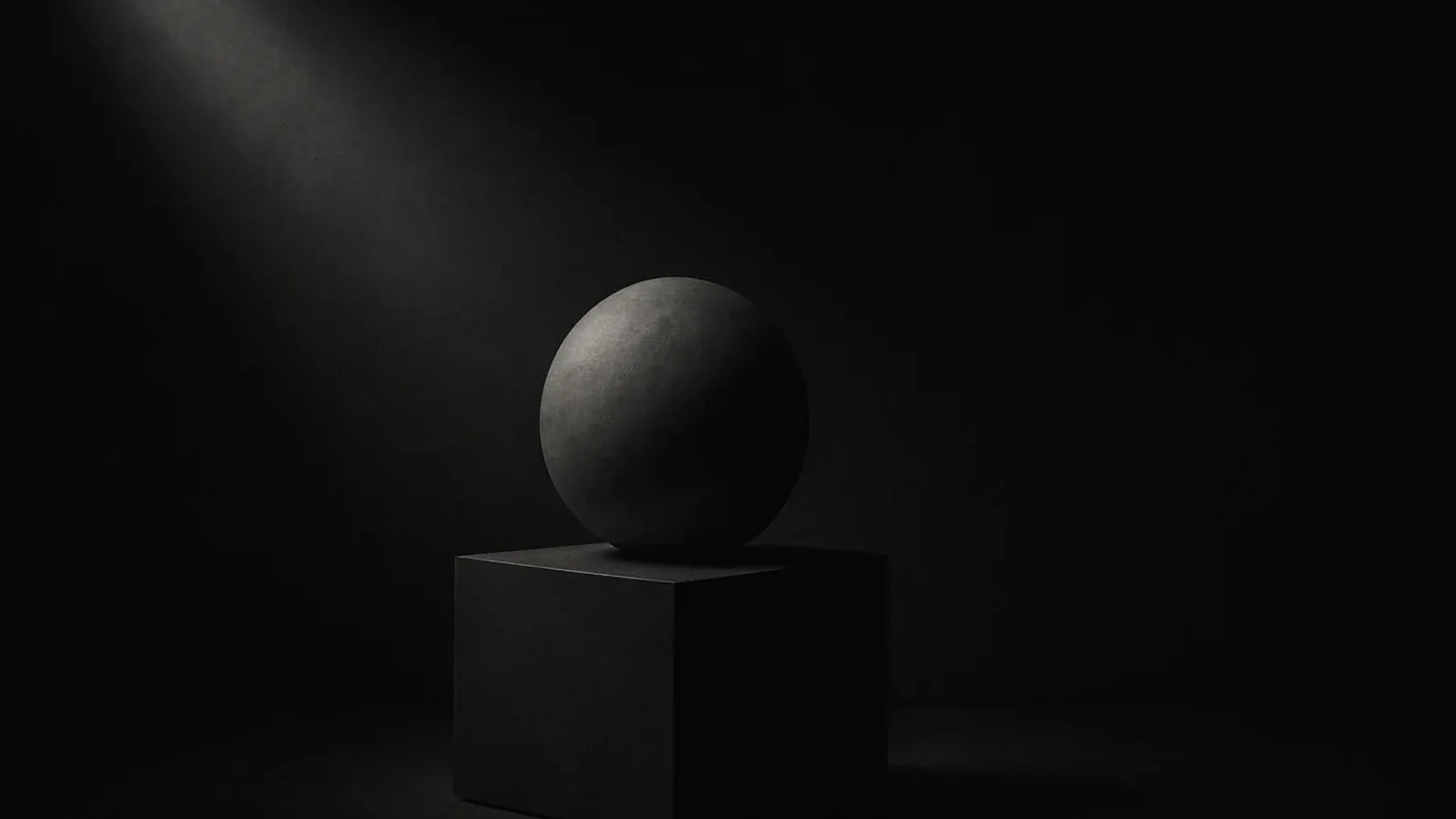
It is also, in a modest dialect, the language of this journal. The covers on these pages — a row of monoliths with light falling on the tallest, a cage of steel in a dark gallery cut by one beam — are chiaroscuro compositions, chosen because the aesthetic says something I believe: most of what matters is decided by what you leave in shadow.
What a Systems Person Sees in It
It is tempting to keep art in a separate room from work — decoration for the walls, culture for the weekends. I have stopped believing in that separation. The problems chiaroscuro solves are attention problems, and attention problems are most of my working life.
A board presentation that highlights everything highlights nothing. A dashboard with forty indicators is a canvas lit from every direction: technically complete, visually mute. The discipline the old painters practiced — decide what the single light falls on, accept real darkness everywhere else — is the same discipline that makes an architecture diagram legible or an executive summary worth the name. Emphasis is a budget. Chiaroscuro is what spending it deliberately looks like.
I intend to keep these notes from beyond the desk occasional and unhurried. But this one felt like the right place to begin, because it explains something about how everything else here is made.
Light is cheap now. Direction is not.