Faith at the Final: Spain, Argentina, and the Catholics' Cup
Executive Summary
One Nil, After Extra Time
On Sunday evening in New Jersey, in the 106th minute of a final that had refused to produce a goal, Nico Williams found Ferrán Torres in the box and Torres finished first-time. Spain 1, Argentina 0. It was Spain’s second World Cup, sixteen years after the first. It was, in all likelihood, Lionel Messi’s last World Cup match, played out by an Argentina reduced to ten men and kept alive almost single-handedly by Emiliano Martínez, whose eleven saves set a record for a final. And Torres, who had come off the bench, became only the second substitute ever to decide a World Cup final, after Mario Götze in 2014.
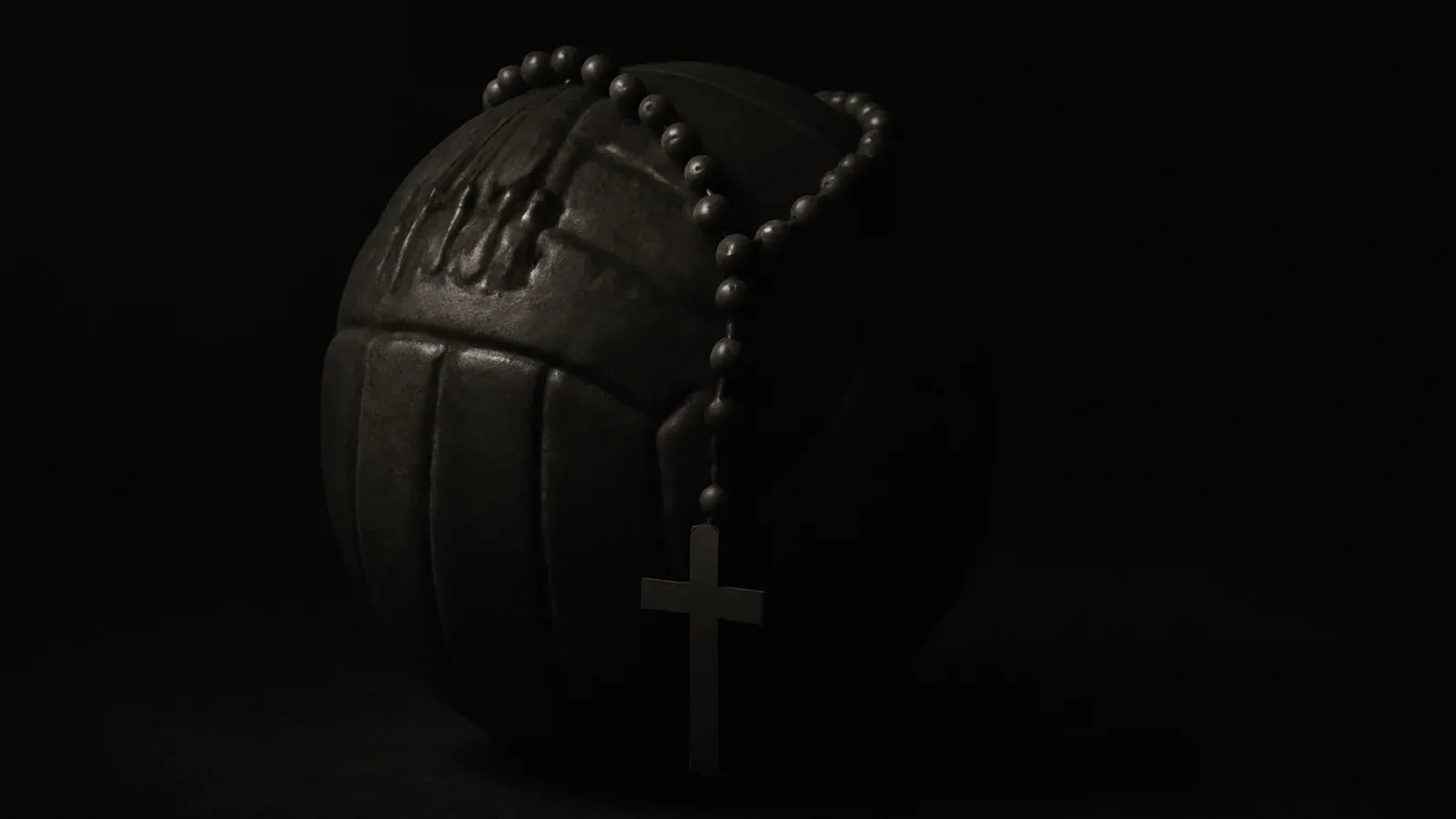
Those are the football facts, and they will settle into trivia soon enough. What interested me more was something the cameras kept catching all tournament, and could not avoid in the final: this was the most openly Catholic World Cup final ever staged, contested by two nations whose shared faith is older than the sport itself.
The Catholics’ Cup
The Catholic press saw it coming. Two days before kickoff, ChurchPop assembled the devotional roster of both squads and called the fixture the Catholics’ Cup — the mother country of Hispanic Catholicism against the homeland of the first Latin American pope, in the final of the most-watched event on earth.
The framing is less of a stretch than it sounds, because the tournament has Catholic bones. Jules Rimet, who willed the World Cup into existence in 1930, was a devout Catholic whose social convictions came straight out of Catholic teaching. And of the eight nations that had ever won the trophy going into this cycle, six are Catholic-majority — Brazil, Italy, Argentina, Uruguay, France, and Spain — holding seventeen of the twenty-two titles between them. Sunday made it eighteen of twenty-three. Correlation is not providence, and I will resist the temptation shortly. But as inheritance, the pattern is real: the game’s heartlands and the faith’s heartlands overlap almost exactly.
What the Cameras Kept Finding
What made this final different was not the flags or the anthems; it was how unguarded the devotion was, on both sides.
Spain’s coach, Luis de la Fuente, describes himself plainly as a practicing Catholic who prays every day and calls his faith a source of strength and security. Mikel Merino dedicated his quarterfinal winner to Saint Fermín, scored on the saint’s own feast day. Nico Williams — the man who supplied Sunday’s assist — posted his thanks to God after matches, and his family’s story runs through the Church: a Catholic priest helped his parents find asylum in Spain after they crossed the Sahara on foot. Not every star shares the faith — Lamine Yamal, Spain’s teenage prodigy, is Muslim — which in its way makes the point better: nothing about this squad’s devotion is institutional. It is personal, and it is simply not hidden.
Argentina’s version is more baroque, as Argentina’s versions of most things are. Lionel Scaloni takes his family to Mass. Messi crosses himself and points skyward on scoring, and carries a tattooed Christ on his arm. Lautaro Martínez slips images of Our Lady of Luján, the country’s patroness, inside his shin guards. Cristian Romero and Lisandro Martínez went viral this tournament for dousing themselves with holy water before matches. By ChurchPop’s count, roughly three-quarters of the squad wear faith-related tattoos. And behind the scenes sits an actual altar: the national team’s locker room travels with an image of Our Lady of Luján that has accompanied the squad for some forty years, joined by Mary Undoer of Knots — the devotion a young Jorge Bergoglio discovered in Germany and carried home to Buenos Aires — and a statue of Saint Expeditus, patron of urgent causes, which may be the most honest piece of football theology I have ever encountered.
The Man Who Came Off the Bench
Then there is the scorer, whom the Catholic press had profiled before he ever touched the ball on Sunday.
Ferrán Torres is a Valencia academy product, born in Foios in 2000 — on February 29, so his actual birthday arrives every four years. He won a Premier League at Manchester City under Guardiola, moved to Barcelona in 2022, and celebrates goals with a shark-fin gesture that earned him the nickname El Tiburón. He has also been unusually open, for a footballer, about anxiety and self-doubt during his difficult early Barcelona years — and unusually open about what steadies him. He carries a cross and an image of the Virgin Mary to the field, and he is careful about what they are not: not lucky charms, he has explained, but reminders — of his faith, and of what he considers truly important. After the final he said it directly: “Thank God, He always gives me the strength to keep going.” Then he brushed the goal aside altogether, saying the only thing he wanted was to hold the trophy for the forty-seven million people it represented.
A believer who scores the only goal of a World Cup final, from the bench, carrying the Virgin in his kit, is the kind of detail a novelist would cut for being too much. Reality kept it in.
Mother and Daughter
There is one more layer, and it is the one that gives the fixture its weight. Spain brought Catholicism to the Americas five centuries ago; Argentina is what that mission became — a country so constitutionally Catholic that until 1994 its president was required by law to profess the faith, and the country that gave the Church the late Pope Francis, the first pope from the Americas. When these two nations meet in a final, the mother church and its most consequential daughter are on the same field.
Even their Catholicisms differ the way a parent’s and child’s do. Spain’s runs through institutions: the brotherhoods, the Holy Week processions, the dense parish networks. Argentina’s runs through popular devotion: improvised shrines, icons in shin guards, holy water on the touchline — and, after the 2022 triumph, the church of Balvanera in Buenos Aires filling up with Argentine flags left as offerings. One faith, two dialects: one processional, one improvised. Sunday put them ninety minutes apart and let the world watch both.
After the Whistle
Let me close the theological door properly: God does not fix football matches. Argentine devotion did not lose this final, Spanish devotion did not win it, and Saint Expeditus presumably watched the extra time with professional neutrality. Anyone reading providence off a scoreline has confused faith with superstition — the exact confusion Torres refuses when he insists the cross in his kit is a reminder, not a charm.
What the final actually showed is rarer and more interesting than a miracle. The most-watched broadcast on earth spent a month pointing its cameras at the pinnacle of secular achievement, and what the cameras kept finding was private devotion, worn without embarrassment: a coach who prays daily, a captain who points upward, an altar in a locker room. In most modern arenas, sincerity of that kind gets laundered into something safer before the public is allowed to see it. Here it simply appeared, on the biggest stage there is, and nobody thought to hide it.
The scoreline is already becoming trivia. The sign of the cross before the whistle is older than the tournament, and it will outlast it.